

When people think about a straight smile, they often picture the shiny brackets and wires of orthodontic treatment. While the process may look simple from the outside, what happens beneath the surface is far more fascinating.
Teeth don’t simply slide into place overnight. They shift slowly and safely through a natural process that involves the bones, gums, and supporting tissues.
For many families, especially in growing cities like Bangalore, orthodontics has become a common step toward better dental health and confidence.
Understanding how braces actually move teeth can help patients feel less anxious and more aware of what is happening during treatment.
This article will explain how orthodontic treatment works, what makes it safe, and why every adjustment is carefully planned.
Why Do Teeth Need Help to Move?
Our teeth are firmly anchored in the jawbone. They are not loose or floating in the mouth,they are held by strong roots and surrounded by a network of fibers called the periodontal ligament.
This ligament acts like a soft cushion between the tooth and bone, absorbing pressure when chewing and speaking. Because the ligament is flexible and the jawbone is living tissue, teeth are not fixed forever in one place.
They can shift if constant, gentle pressure is applied over time. This is where orthodontic treatment plays a role. By applying carefully controlled force, orthodontists can guide teeth into healthier positions.
Modern solutions, such as Soft Clear Aligners, use this principle to move teeth gradually while offering comfort and a nearly invisible appearance. Without such help, teeth that grow crowded, crooked, or misaligned can cause chewing problems, speech issues, and difficulties with cleaning.
The Science Behind Tooth Movement
The Role of the Periodontal Ligament
The periodontal ligament is like a hammock that supports each tooth in its socket. When pressure is applied on one side of a tooth, the ligament compresses on that side and stretches on the opposite side.
This small but important change signals the body to remodel the bone.Cells called osteoclasts break down bone where pressure is applied, while osteoblasts build new bone where the ligament is stretched.
This process is slow and steady, which is why orthodontic treatment may take several months to years. The body adapts naturally to the gentle force, making the process safe instead of rushed or forced.
Controlled Pressure is Key
The pressure applied by braces is never random. If too much force is used, it could harm the roots, gums, or jawbone. If too little pressure is applied, no movement happens at all.
That balance is the reason orthodontists carefully adjust brackets and wires during regular visits. Each change is calculated to maintain safe, steady progress.
How Braces Apply Force
Brackets and Wires Working Together
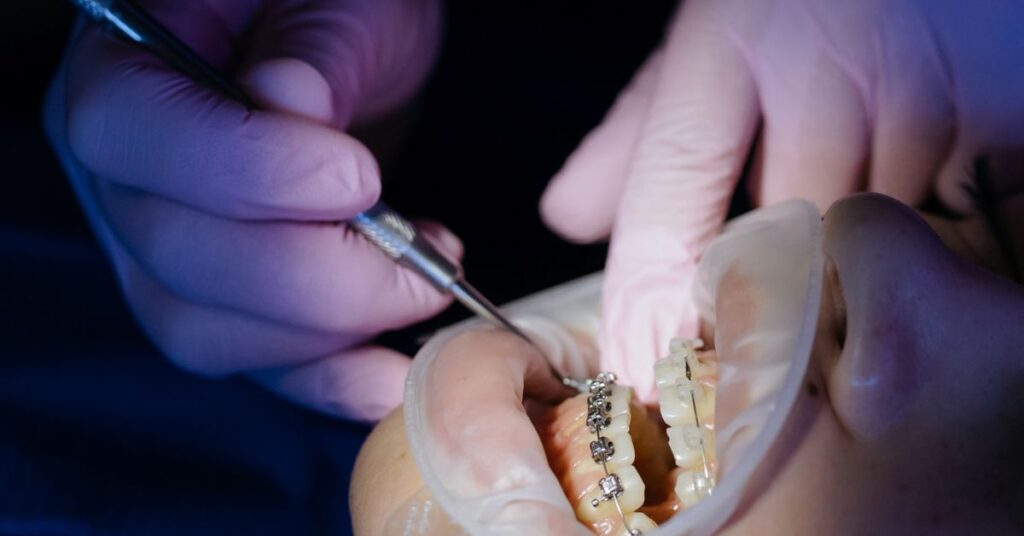
Brackets are the small metal or ceramic pieces attached to the surface of each tooth. These brackets hold the archwire, a thin metal wire that connects all the teeth.
The wire has what orthodontists call a “memory” of its proper shape. When it is bent to fit misaligned teeth, it gradually returns to its original curve, pulling or pushing the teeth along with it.
Small elastic ties or bands may also be added to help guide bite alignment or fine-tune the movement. Every part of the system works together, applying gentle force to move teeth little by little.
Step-by-Step Adjustments
Treatment does not begin with strong wires or heavy force. Instead, orthodontists use lighter wires in the early stages to begin movement.
Over time, as teeth shift into better positions, stronger wires are introduced to guide them more precisely.Each appointment builds on the last.
Adjustments are made in small steps, protecting the teeth, roots, and tissues from unnecessary stress. This gradual plan is why orthodontic care can take time but remains safe.
Why Orthodontists Monitor Progress Closely
Orthodontic treatment does not involve placing brackets and waiting for results. Progress must be checked often. Regular visits allow the orthodontist to track how teeth are responding and make corrections when needed.
For example, if a tooth is moving slower than expected, adjustments can encourage more progress. If a bracket is irritating the cheek or gum, changes can reduce discomfort. Ongoing supervision is one of the biggest reasons orthodontic care is both safe and effective.
How Long Does It Take for Teeth to Move?
The Pace of Safe Movement
On average, teeth move about one millimeter per month during orthodontic treatment. This may sound small, but over time, those changes lead to dramatic improvements. Trying to move teeth too quickly could damage the bone or shorten the roots, so the slow pace is actually safer.
Factors That Influence Treatment Time
The length of treatment depends on several factors. Age is one. Younger patients usually experience faster progress because their bone is still developing and easier to adapt.
The complexity of the case is another factor. Severe crowding, spacing, or bite issues require more time to correct than mild misalignments.
Patient habits also matter. Wearing elastics as instructed, keeping appointments, and avoiding broken appliances all help maintain steady progress. Missing visits or not following directions can delay results.
In Bangalore and other busy cities, orthodontists often remind patients that cooperation plays a major role in completing treatment on time.
The Role of Patient Responsibility
Orthodontists provide the tools, but patients carry responsibility too. Treatment safety and success depend greatly on daily care.
Oral Hygiene Care
Food easily gets trapped around brackets and wires. Without careful cleaning, this can lead to cavities or gum infections. Brushing at least twice a day and flossing once daily are essential. Special orthodontic brushes or floss threaders make cleaning easier and more thorough.
Avoiding Harmful Foods
Hard foods like nuts or crunchy candy can break brackets or bend wires. Sticky foods like caramel can pull appliances out of place. Such accidents delay progress and may interfere with the safe movement of teeth.
Wearing Appliances as Directed
Elastics, expanders, or other special appliances are often part of treatment. They must be worn exactly as instructed. Skipping their use may lead to longer treatment times or incomplete results.
Are There Risks in Moving Teeth?
Orthodontics is very safe, but like any medical process, there are small risks.
Root Resorption
In some cases, the roots of teeth may shorten slightly during treatment. This effect is usually minor and rarely affects long-term stability. Orthodontists monitor for this with X-rays during treatment.
Gum and Bone Health
If oral hygiene is neglected, plaque buildup can lead to gum swelling or even bone problems. This is why brushing and flossing remain critical throughout treatment.
Discomfort
Mild soreness is common after adjustments. This is not harmful,it shows that teeth are responding to pressure. The discomfort fades within a few days and can be managed with over-the-counter relief.Overall, risks are low when teeth are moved gradually and monitored closely.
Examples of Successful Movement
Imagine a teenager with crowded front teeth. Over eighteen months, light pressure slowly moved each tooth into line. The gums stayed healthy, and the bite improved naturally.
Consider also an adult with a deep overbite. With steady adjustments and elastic wear, the teeth shifted safely, improving both function and appearance. These examples show that orthodontics works best when the natural biological process is respected.
Why Braces Are Still Widely Used
Even though clear aligners and other modern techniques are now available, traditional orthodontic treatment continues to be widely trusted. One reason is that it can handle even the most complex cases, something aligners may not always achieve.
Today’s orthodontists use lighter wires and more comfortable materials than in the past, making treatment easier to tolerate.
For patients in places with growing awareness of dental health, such as Bangalore, orthodontics remains a dependable choice. Clinics like Teeth Aligners in India often explain every step so patients feel confident about the safety of their care.
Conclusion
Tooth movement through orthodontics is not magic,it is a carefully guided process. The periodontal ligament, bone remodeling, and controlled pressure all work together to shift teeth into healthier positions.
With proper planning, step-by-step adjustments, and patient cooperation, orthodontic care remains one of the safest ways to improve a smile.
Whether correcting crowded teeth, aligning the bite, or simply creating a more confident smile, orthodontists rely on time-tested methods that respect how the body adapts.
With regular visits, strong oral hygiene, and a commitment to following instructions, patients can enjoy results that last for years.
For families and individuals considering orthodontic care, the journey is well worth the effort. A healthier, brighter smile is the reward at the end,a smile guided safely every step of the way by experts who understand the process deeply.
If you want to explore this path further, reaching out to clinics like Teeth Aligners in India can be a meaningful first step toward your new smile.
